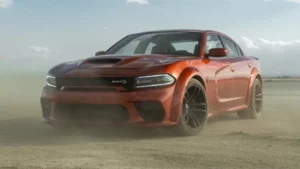

This week in the automotive world felt less like a news cycle and more like a turning point. A bold Chinese push toward the American market. Japanese giants quietly exploring strategic alliances. A possible V8 comeback driven by passionate Jeep fans. An aggressive electric move from Ford. And then Smart… rewriting its own story with 645 horsepower.
It was a week where the industry’s internal tension became impossible to ignore — a visible clash between heritage and reinvention, emotion and efficiency, displacement and electrification.
China Isn’t Just Exporting Anymore — It’s Moving In

China is no longer content with being the world’s largest exporter of vehicles. With over 8 million cars shipped globally and a 30% surge in exports, it has already reshaped global supply chains. Now, the focus shifts to something far more ambitious: building factories inside the United States to bypass the 100% tariffs blocking direct imports.
This is not just about low pricing. It is about software integration, advanced EV platforms, and production scale. The rise of BYD and the global expansion of Geely — potentially leveraging Volvo’s South Carolina facility — signal a calculated long-term strategy. If Chinese brands successfully localize production in America, pricing dynamics and competitive balance in one of the world’s most profitable markets could fundamentally shift.
Japan Responds With A Partnership Of Necessity

While China accelerates, Japan recalibrates. Nissan, Honda, and Mitsubishi are exploring cooperation that could evolve into a strategic alliance. Rising development costs for electrification and software make solo survival increasingly difficult.
Official statements hint at shared models, coordinated technologies, and a sharp focus on the U.S. market, especially under tariff pressure. Meanwhile, Nissan is aggressively restructuring through its Re:Nissan plan, targeting savings of 250 billion yen, shutting down seven production sites, and improving engineering efficiency by 15%.
This is not collaboration by choice — it is collaboration by survival.
The HEMI Question Isn’t About Numbers — It’s About Identity

On American soil, the debate takes a different tone. When Jeep discontinued the 5.7-liter HEMI V8 in the Grand Cherokee, many saw it as the symbolic end of an era. Eight cylinders gave way to turbocharged efficiency. The 324-horsepower Hurricane four-cylinder replaced the 357-horsepower V8.
But enthusiasts pushed back. And Jeep listened.
Now, signals from engineers suggest that the 5.7-liter V8 — with its 357 horsepower and 529 Nm of torque — may return. This isn’t about outperforming the Hurricane on paper. It is about sound, character, mechanical presence. It is about what a Jeep is supposed to feel like.
Ford Enters The Electric Fight With A $30,000 Statement

As electrification intensifies, Ford makes a bold play: a mid-size electric pickup priced at just $30,000 under the Universal EV project, scheduled for 2027.
Aerodynamics shaped by Formula 1 expertise add up to 80 kilometers of additional range. Gigacasting reduces structural components from 146 parts to just two, cutting weight by 27%. LFP batteries, a separate 48-volt system, and 1.2 kilometers less wiring reflect ruthless efficiency.
Ford’s message is clear: electric trucks do not have to be premium-priced luxuries. They can be accessible — and still intelligent.
Smart Just Broke Its Own Stereotype

Then came the shock of the week.
Smart — once known as a compact urban commuter — unveiled the #5 Brabus with 645 horsepower and 710 Nm of torque. 0 to 100 km/h in 3.8 seconds. A 100 kWh battery delivering up to 540 kilometers of range. 10% to 80% charging in under 18 minutes.
Inside, three digital screens, a 1,190-watt Sennheiser sound system, multiple driving modes including Off-Road, and a towing capacity of 1,600 kg redefine what a “small” vehicle can be.
Smart didn’t just build a fast car. It shattered expectations.