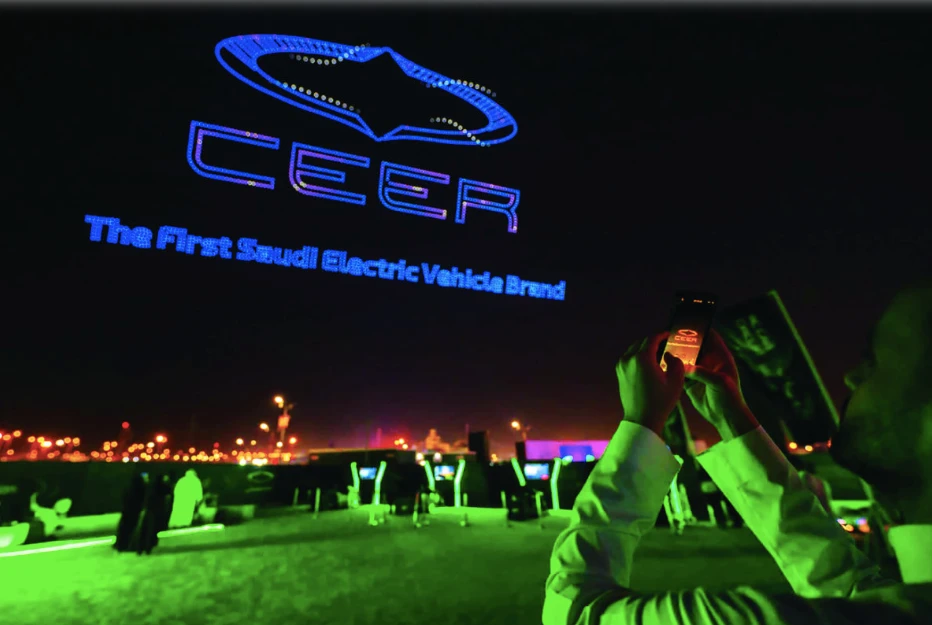
After years of plans, investment, and talk about building a homegrown Saudi automotive industry, we’re finally about to see what all that work has produced. Ceer will officially unveil its first electric vehicles on September 21, 2026, with both a sedan and an SUV set to make their debut.
It’s a major moment for a company that was only established in 2022. Ceer’s ambitions go well beyond becoming another EV brand competing for buyers in Saudi Arabia. The company wants to build cars locally, handling everything from design and engineering to manufacturing, sales, and after sales support.
From An Ambitious Saudi Project To Actual Cars
Ceer was created as a joint venture between Saudi Arabia’s Public Investment Fund and Foxconn, with the goal of becoming the Kingdom’s first homegrown automotive manufacturer and OEM.
This was never meant to be simply an assembly operation for cars developed elsewhere. Ceer is involved in designing and engineering its vehicles, sourcing components, testing and validating them, and ultimately putting them into production. Sales and servicing will also be handled by the company once the cars reach customers.
That’s what makes the September reveal so significant. For the past few years, we’ve mainly heard about Ceer through investments, partnerships, construction updates, and ambitious plans. Now we’re finally getting close to seeing the cars themselves.
CEO James DeLuca previously called 2026 the “year of Ceer,” and with the company’s first two vehicles now just days away from their debut, that statement is starting to make a lot more sense.
A Major New Factory In King Abdullah Economic City
Ceer’s manufacturing operations will be based at the King Salman Automotive Cluster in King Abdullah Economic City, where the company is building what is expected to become one of the region’s most advanced automotive manufacturing facilities.
Around $1.3 billion has initially been invested in the project, with vehicle production expected to begin in the fourth quarter of 2026.
There are different figures surrounding the factory’s eventual production capacity. One estimate puts the target at 170,000 vehicles per year, while another suggests the facility could eventually produce as many as 240,000 vehicles annually once all stages are completed.
Whichever figure ultimately reflects the factory’s full capacity, the scale of the investment makes Ceer’s intentions clear. This isn’t a small scale experiment. The company is building an operation designed to manufacture cars in serious numbers.

From 20 Employees To A Team Of 2,300
The factory isn’t the only part of Ceer that has grown quickly. The company started with around 20 employees in 2022 and now has a workforce of roughly 2,300 people, combining Saudi talent with experienced professionals from across the global automotive industry.
Ceer is also working to build a local supply chain, with the company aiming for 45 percent local content by 2034.
To get there, it has partnered with an extensive list of international automotive and technology companies, including BMW, Hyundai Transys, Rimac, Siemens, Sabelt, Isoclima, ANDRITZ Schuler, Dürr, XYG, Lear, Benteler, Fangxin, Shin Young, and JVIS.
Saudi companies are part of the picture as well, including Zamil Group, Abdul Latif Jameel, and Balubaid Group’s APICO. Bringing more local suppliers into the project will be important if Ceer wants to create a genuine Saudi automotive manufacturing ecosystem rather than simply relying on imported components.
EVs Built With The Gulf In Mind
One particularly interesting part of Ceer’s approach is that its vehicles are being developed and tested specifically for Saudi Arabia and the wider region.
That could prove important. An EV in Saudi Arabia has to deal with intense summer temperatures, heavy air conditioning use, and plenty of long distance highway driving. Those conditions can place very different demands on an electric car compared with everyday driving in cooler markets.
We’ll have to wait for the official unveiling before we can judge how Ceer has addressed those challenges. The company has yet to reveal some of the details enthusiasts and potential buyers will care about most, including battery capacity, driving range, motor output, charging speeds, performance figures, pricing, and warranty coverage.
That gives us plenty to watch for on September 21, when we should finally get a much clearer picture of how Ceer intends to compete with the growing number of electric cars already on the market.

This Is About More Than Two Electric Cars
Ceer’s significance goes beyond the vehicles themselves. The company forms part of Saudi Arabia’s wider effort to develop new industries and diversify its economy under Vision 2030.
Current estimates suggest Ceer could contribute around SAR 30 billion, or roughly $8 billion, to Saudi Arabia’s GDP while improving the Kingdom’s trade balance by around SAR 80 billion.
The project is also expected to create around 30,000 direct and indirect jobs, with Saudi nationals targeted to make up 80 percent of the company’s direct workforce.
Ceer also sits alongside the Public Investment Fund’s other automotive investments, including Lucid. Taken together, these projects point to a broader strategy that goes beyond establishing a single car brand. The aim is to develop an automotive ecosystem covering manufacturing, suppliers, technology, and the infrastructure needed to support electric vehicles.
September 21 Will Give Us Our First Proper Look At Ceer
Nearly four years after Ceer was established, we’re finally about to see the cars the company has been developing behind closed doors.
The first sedan and SUV will make their debut on September 21, and once the covers come off, attention will quickly turn from how they look to what they can actually do.
How much range will they offer? How powerful will they be? How well will they handle Gulf temperatures? And perhaps most importantly for buyers, how much will they cost?
Those answers will ultimately tell us how competitive Ceer’s first vehicles really are. But reaching the point where production ready cars are about to be revealed is already an important milestone, especially with manufacturing scheduled to begin before the end of 2026.
After years of talking about a Saudi made car, we’re now only days away from seeing Ceer’s first real answer.